You twist an ankle on a hike, or your neck seizes up after a long day at a desk, and someone immediately offers advice: “Put ice on it!” — or is it heat? Both are classic home remedies, both genuinely work, but they do opposite things. Choosing the wrong one at the wrong time can increase swelling or prolong stiffness.
This simple guide settles the question: how cold and heat each work, which injuries and aches each one suits, the situations where you should never use them, and how to apply both safely at home. Keep one rule in your head and you will get it right most of the time: new injury and swelling — cold. Stiffness and tight muscles — heat.
How a Cold Pack Works
Cold narrows the blood vessels in the area (vasoconstriction), slows local circulation and numbs the nerve endings. That combination reduces swelling, limits bruising, and dulls sharp pain. Cold is the right tool in the first 24–48 hours after an injury, when the body is flooding the area with fluid and inflammation is building.
Use cold for:
- Fresh sprains and strains (ankle, wrist, knee)
- Bumps, knocks and sports injuries with visible swelling
- A sudden flare of tendon pain after overuse
- Acute lower-back strain in the first day or two, if cold feels relieving
- Reducing swelling after dental work, on the cheek
How Heat Works
Heat does the opposite: it widens blood vessels, increases circulation, and helps tight muscles relax. Fresh blood flow brings oxygen and nutrients that support healing in tissues that are stiff rather than swollen. Heat feels comforting because it directly eases muscle spasm and the guarded, tense feeling around an aching area.
Use heat for:
- Stiff necks and shoulders from tension or poor posture
- Chronic, recurring aches such as long-standing lower-back tightness (without a fresh injury)
- Stiff, achy joints in the morning, especially arthritic joints without swelling
- Muscle cramps and period cramps
- Warming up tight muscles before gentle stretching
The Quick Decision Guide
- Did it just happen (last 48 hours) and is it swollen? → Cold.
- Is it stiff, tight or tense, with no recent injury? → Heat.
- Is the joint swollen and warm to the touch, even if it’s an old problem flaring up? → Cold during the flare.
- Still unsure? → Cold is the safer default for anything recent; never put heat on a fresh injury.
The Two Mistakes That Make Things Worse
Heat on a Fresh Injury
Applying heat to a new sprain increases blood flow to tissue that is already flooding with fluid — swelling grows, bruising spreads, and healing slows. Save the heating pad until at least 48 hours have passed and swelling has clearly gone down.
Ice on a Stiff Muscle
Cold makes muscles tighten further. Icing a tense neck or a back that’s stiff from sitting all day usually makes it feel worse. That kind of ache needs warmth, movement and gentle stretching instead.
How to Apply a Cold Pack Safely
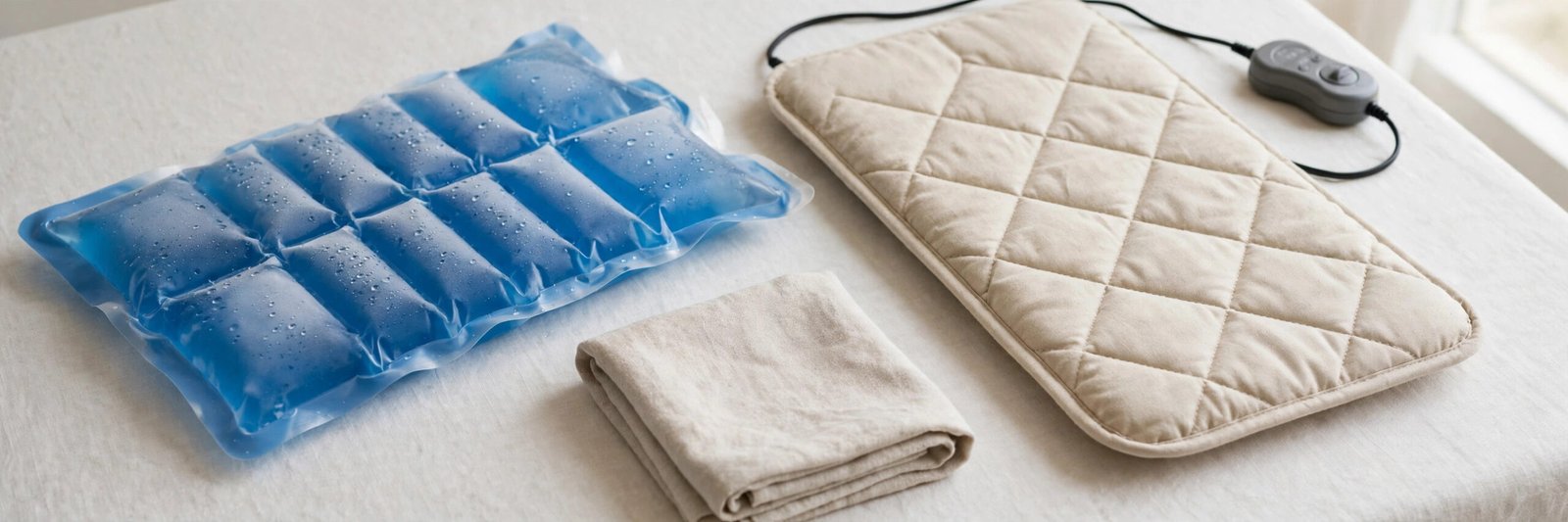
- Use a gel pack, a bag of frozen peas, or ice in a sealed bag. Frozen peas mold nicely around ankles and knees.
- Always put a thin towel or pillowcase between the pack and your skin. Ice directly on skin can cause frostbite.
- Apply for 15–20 minutes at a time, then take a break of at least 40 minutes before repeating.
- For a sprain, combine with the basics: rest the area, elevate it above heart level when you can, and use a light compression bandage if it feels supportive (not so tight that toes or fingers tingle or change color).
- Stop if the skin becomes blotchy, burning, or more painful — remove the pack and let the area warm up naturally.
How to Apply Heat Safely
- Use a heating pad on its lowest effective setting, a hot water bottle, a warm damp towel, or a heat wrap.
- Apply for 15–20 minutes at a time with a layer of clothing or a towel as a barrier.
- Never fall asleep with a heating pad on. Burns from heating pads during sleep are a common and preventable injury.
- Do not use heat on broken skin, open wounds, or areas with poor circulation.
- Heat should feel comfortably warm, never hot. If you are reaching for the highest setting to feel anything, that is a warning sign about sensation in the area — see the cautions below.
Special Cases Worth Knowing
Back Pain
For a brand-new back strain, some people prefer cold for the first day or two; for the familiar, stiff, end-of-day backache, heat usually wins. Whichever you choose, gentle movement beats bed rest for most everyday back pain — and persistent back pain, or pain shooting down a leg, needs professional assessment.
Arthritis
Both can help, at different moments: heat for morning stiffness, cold for a joint that is hot and swollen after activity. Many people with arthritis keep both options at home and choose by how the joint feels that day.
After Exercise
Ordinary next-day muscle soreness (the dull ache 24–48 hours after a hard workout) does not need ice. A warm shower, gentle movement and sleep do more. Save cold packs for actual injuries — a rolled ankle is different from sore quads. And note that pain itself can disturb rest; if aches are keeping you up, our guide to natural remedies for better sleep covers building a wind-down routine that helps.
Supporting Recovery Naturally
Temperature therapy handles the local symptoms. Warm, soothing drinks are a comforting add-on while you recover — ginger, for example, has traditional anti-inflammatory associations, and our article on ginger benefits covers its properties and safe use. Just keep remedies like these in perspective: they support comfort, they don’t repair a torn ligament.
Who Should Be Extra Careful
- Diabetes or nerve damage (neuropathy): Reduced sensation means you may not feel a pack that is too cold or a pad that is too hot. Use milder temperatures, shorter sessions, and check the skin visually. Many doctors advise avoiding ice and strong heat on feet with poor sensation altogether.
- Poor circulation or Raynaud’s: Cold can be harmful where blood flow is already limited. Ask your doctor before icing.
- Pregnancy: Avoid applying strong heat over the abdomen, and avoid heating your whole body (very hot baths) for long periods.
- Young children and older adults: Skin is thinner and more burn-prone at both ends of life. Use gentler temperatures and supervise application.
- Over the front of the neck, on the eyes, or on open wounds: Neither ice nor heat belongs in these spots without medical guidance.
See a Doctor If…
- You cannot bear weight on the injured limb, or a joint looks deformed or out of place.
- Pain follows a serious fall, accident or blow to the head or spine.
- There is numbness, weakness, or loss of bladder/bowel control with back pain — treat this as urgent.
- Swelling does not start improving after 2–3 days, or pain is still severe after a week of home care.
- The area is hot, red and increasingly painful, or you have a fever — possible signs of infection.
- Chest pain, or pain spreading to the arm or jaw — call emergency services; do not treat it with a hot water bottle.
Medical Disclaimer
Disclaimer: The information in this article is for general educational purposes only and is not medical advice. Home remedies are not a substitute for professional diagnosis or treatment, and natural ingredients can still cause allergies or interact with medicines. Talk to your doctor or another qualified health professional about injuries or pain that are severe, unusual or slow to improve.
Frequently Asked Questions
How long after an injury should I keep using ice?
Ice is most useful in the first 24–48 hours, while swelling is actively developing. After that, once swelling has stopped growing, you can usually transition to gentle movement and, if stiffness is the main problem, heat. Continuing to ice for many days rarely adds benefit.
Can I alternate ice and heat?
Alternating (contrast therapy) is sometimes used for chronic limb swelling under professional guidance, but for everyday home use it usually just muddles two clear jobs. Pick based on the main problem — swelling means cold, stiffness means heat — and reassess the next day.
Is a bag of frozen vegetables as good as a gel pack?
Yes. Frozen peas or corn conform to the shape of a joint and work just as well. Mark the bag clearly so it doesn’t end up back in the food supply after being thawed and refrozen several times, and always use a towel barrier against the skin.
What if both swelling and stiffness are present?
Treat the swelling first with cold until it clearly settles, because adding heat to a swollen area makes the swelling worse. Once the swelling phase passes, heat becomes the better choice for the remaining stiffness.
Why does my heating pad say not to use it while sleeping?
Because burns happen slowly and silently. Lying on a heating pad traps heat against the skin, and during sleep you won’t notice it getting too hot. Use heat while awake, set a timer for 15–20 minutes, and remove it before you get drowsy.